
Babarlai Nadi: A Village Lifeline in a Changing Climate
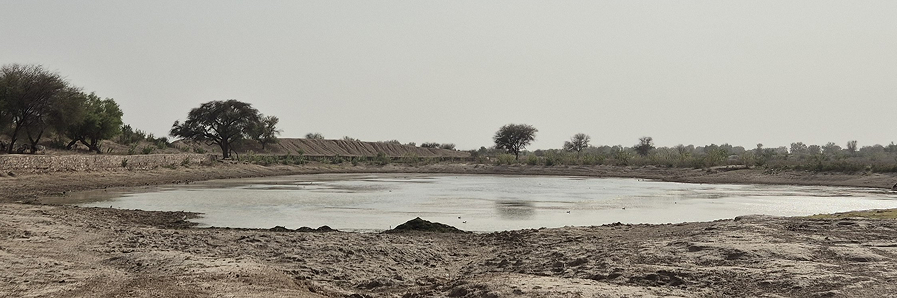
For decades, Babarlai Nadi has helped a Rajasthan village survive the region's harsh climate. As rain becomes less predictable and water disappears faster, villagers are working to keep alive a pond that sustains both livelihoods and daily life.
.webp)
Author: GROW+ Published Date: 22 September 2026
Editor's Note
Babarlai Nadi is one such story. It shows how the impacts of climate change are being felt through a village pond that supports people, livestock, and wildlife alike. It also reminds us that resilience is often built through collective effort, local knowledge, and a shared commitment to protecting the resources that sustain life.
Through the GROW+ network, we are documenting these changing realities from across the country through the organisations that have worked alongside communities for years. Their observations, built over decades of trust and engagement, offer a close look at how people are experiencing a changing climate and the ways they are responding with their own knowledge, ingenuity and collective action.
This story comes from Vasundhara Sewa Samiti, a grassroots organisation working alongside rural communities in the desert and semi-arid landscapes of western Rajasthan, India. It has been translated from the original Hindi, with only light editorial edits by the GROW+ team. You can read the original Hindi submission below.
Translation
Babarlai Nadi, Jaynagar village, Gangawas Gram Panchayat, Block - Kalyanpur, Balotra, Rajasthan
Today, Babarlai Nadi is not just a public pond — it has become the foundation of life for the people, animals, and birds of the entire region. This nadi (pond) is not merely a water source; it is the story of struggle, community cooperation, and tradition that brought life to barren, desolate land. Even today, when villagers sit on the banks of this nadi, they don't just see water — they feel the hard work, struggle, and collective effort of their ancestors.
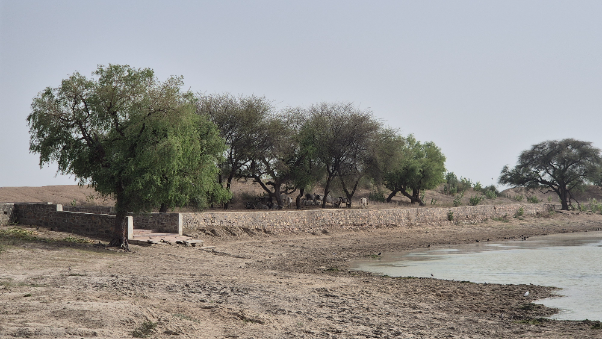
Image Courtesy: VSS
Thanaram ji, a resident of the Gangawas area near Babarlai Nadi, and the village women shared that many years ago, this entire area was known as dense forest and barren wasteland. At that time there was no permanent settlement here — only wild bushes, desolation, and fear of wild animals surrounded the area, and people were afraid to settle here. This entire region was then under the rule of the Kornawati Rajput kingdom. According to villagers, the Thakur Sahib of Kornawati was the first to bring some families from Didoubera village and settle them in this area. At that time, dense forest and barren land stretched in every direction. Gradually, the forests were cleared, the land was made fit for farming, and people began cultivation here. Over time, small settlements began to form, and people started hoping for a better life.
But amid all these efforts, one problem stood before the people every single day — the water problem. Farming had begun, but there was no permanent source of drinking water. Women had to travel several kilometers to distant settlements to fetch water, and the situation grew even harder during summer. Often an entire day would be spent just managing the water supply. These difficult circumstances pushed people to come together and search for a solution. Gradually, the community began digging a small nadi. At first it was just a small effort to capture rainwater, but years of hard work, community cooperation, and continuous care turned this small nadi into what is today a large public pond.
As the population grew, people continued the tradition of cleaning and digging it out every year, so that water could be preserved for longer. This is why, over time, this nadi became a permanent source of drinking water for the entire region, and even today it remains the lifeline for thousands of people and animals. Thanaram ji explains that water is typically available in this nadi for 9 to 10 months of the year. As long as the water lasts, around 400 households depend on it. Not only village residents, but also around 2,000 buffalo and 10,000 to 12,000 sheep and goats quench their thirst from this nadi's water. Since animal husbandry is the main source of livelihood in this region, the importance of this nadi is even greater.
But conditions are no longer what they used to be.
Thanaram ji expressed concern, explaining that even in the past there were long stretches without rain, during which the nadi's water level would gradually drop. But now, due to climate change, the situation has become even more serious. Due to irregular rainfall, extreme heat, and steadily rising temperatures, the nadi's water now dries up much faster than before. He said that today the situation has become such that if it doesn't rain for a few days, whatever water remains in the nadi dries up completely.
He also explained that this water shortage doesn't affect humans alone — the village's animals and birds are also bearing the brunt of the drought. During summer, animals must wander far in search of water, and birds too are often seen flying about searching for water. For villagers, this sight is deeply distressing and emotional, because this nadi has become part of the entire natural life cycle, not just a water source.
Thanaram ji shared another important point — that in the past, rainwater from fields near the nadi would naturally flow into it. There was a constant flow of water between the fields and the nadi, which allowed water to be retained in the nadi for a long time. But gradually, this natural pathway has been blocked. Because a paved road was built along the route, and the small path that ran beneath it has also been closed off, rainwater can no longer reach the nadi as it used to, causing the water level in the nadi to continuously decline.
Villagers said that despite the changing climate and declining rainfall, this nadi still remains the greatest support for the people. Although rainfall used to be more regular in the past, weather patterns are now changing rapidly — sometimes rain comes late, and sometimes there is sudden, excessive rainfall. Despite this, the community has made continuous efforts to preserve this nadi. Every year, cleaning and digging work is carried out under the Mahatma Gandhi National Rural Employment Guarantee Act (MGNREGA) to conserve and rebuild the nadi, ensuring water availability remains steady. In addition, local people also pool funds through community cooperation to get the nadi cleaned.
The village women shared that in 2018, with community support, the nadi was deeply excavated using a JCB machine. After this work, the nadi's water storage capacity increased, and now water remains available for longer than before — sometimes even throughout the entire year, providing great relief to both people and animals.
This story is not just about one pond — it is the story of a community mindset where people consider water conservation their own responsibility. Babarlai Nadi today stands as an example that if community, tradition, and local effort work together, water sources can be kept alive even amid a changing climate crisis.
About Vasundhara Sewa Samiti (VSS)
VSS works alongside rural communities in western Rajasthan to strengthen their ability to thrive in a challenging and changing environment. The organisation focuses on practical, community-driven solutions that improve water security, support sustainable livelihoods, and strengthen resilience to climate and environmental stresses. By fostering local leadership and collective action, VSS helps communities build on their own strengths, knowledge, and traditions to create lasting change.
To learn more about the organisation and its work, visit https://vasundharasewasamiti.org/
Related Stories
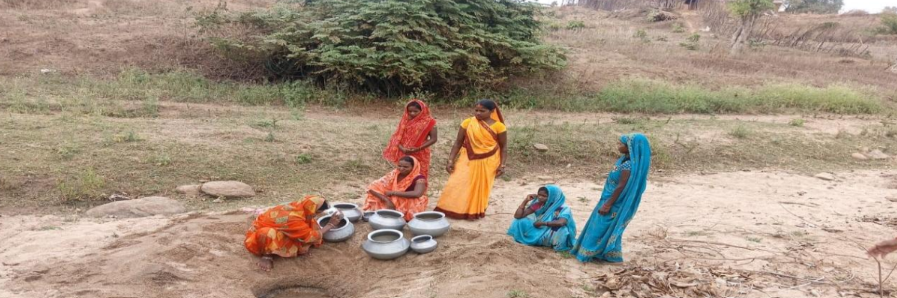
How a Jharkhand Village Is Adapting to a Changing Monsoon
The story of Madhaiya's fight for water, farming and climate resilience as climate change reshapes rainfall patterns in rural Jharkhand.